
On October 14, Cielo's Talent Benchmark put a hard number on the enterprise hiring gap: 87% of large employers raised their recruiting tech spend, yet only 31% can scale sourcing and screening without adding recruiters.
Cielo and Researchscape International surveyed 396 HR leaders at organizations with 2,500 or more employees in the United States, United Kingdom, and India, from July 14 to September 1, 2026. The finding is not that technology failed. It is that more spend did not rewrite the hiring model.
For large employers and public agencies, the takeaway is practical. Adding a tool does not change how work moves through the hiring process. Changing the workflow does.
Spending went up, but capacity did not keep pace
Eighty-seven percent of respondents increased their talent acquisition technology investment over the past 12 months, according to Cielo.
Fifty-six percent said AI gives them some agility, but recruiter headcount still limits their capacity. Only 31% said they can scale sourcing and screening without adding recruiters.
For most enterprises, hiring volume and recruiter headcount still move together. When requisitions spike, the plan is still to find more recruiters.
Cielo CEO Marissa Geist put it directly: "Adding AI to the same hiring model is not transformation. In a business environment where hiring demand can shift quickly and unpredictably, organizations need a model that can respond just as fast. That requires rethinking the work itself, where AI can execute, where human judgment creates the most value and how the two come together to create greater agility."
Governance and measurement are still catching up
The survey also points to gaps in how teams oversee automated steps and prove results.
Sixty-one percent report human-in-the-loop guardrails. Fewer track the effects: 45% track stakeholder experience, and 43% audit automated workflows for bias, fairness, and adverse impact, per the full report.
Measurement of business value is thinner still. Just 23% track talent acquisition outcomes tied directly to enterprise value, business growth, or the bottom line.
Work design is also in flux. Only 29% have an enterprise-wide dynamic skills framework, while 45% are still transitioning from traditional job structures.
For public-sector and regulated employers, the audit number deserves attention. If fewer than half of large organizations formally audit automated workflows, many teams may be running steps they cannot fully explain to a review board.
Applicant volume makes the gap wider
The capacity problem grows when applications pile up. Workday's October 2026 Global Workforce Report found the median number of applicants per filled job rose to 69, up from 58 a year earlier. Time to fill held at about 60 days. Workday also found that 84% of job seekers used AI in their search.
More applicants with the same number of recruiters means more review per person. If screening still depends on reading every application by hand, extra volume turns into a backlog.
Workday's data adds a retention signal for public employers. Across every industry it analyzed, employees who plan to stay are less likely to recommend their employer, and that gap reaches 11 points in the public sector. Referrals and word of mouth can be harder to count on when current staff are hesitant to recommend the job.
Where to fix the workflow first
You can start without a new platform. Look at where hiring volume still depends on adding people, and redesign those steps.
- Screen with structure. Use consistent knockout and qualification questions for each job family, so applicants are sorted the same way every time and recruiters review a ranked shortlist instead of a raw pile.
- Make the pipeline visible. Every recruiter and hiring manager should see where each candidate sits and how long they have been there. A stage where candidates stall usually points to a capacity problem.
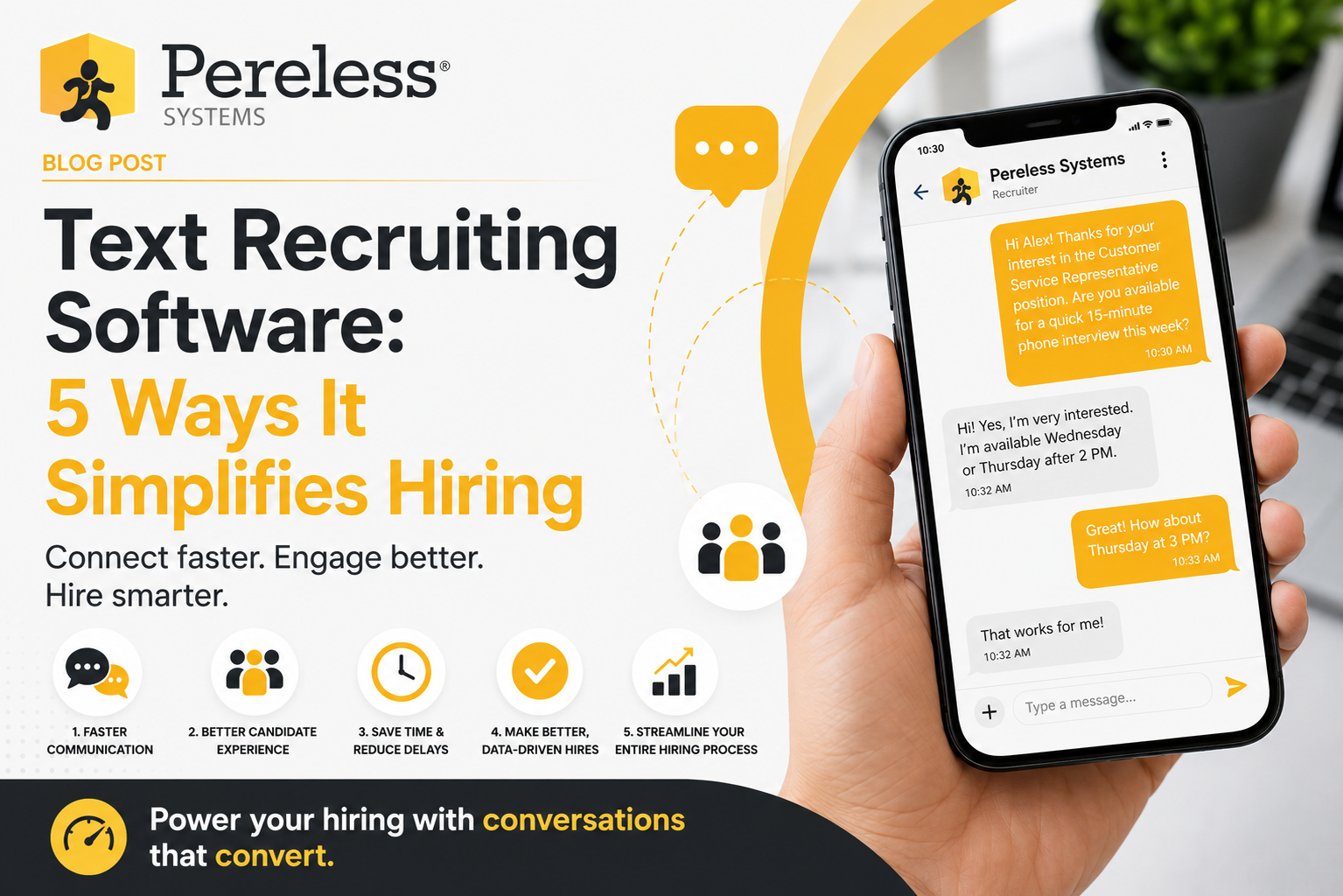
- Take scheduling off recruiters' plates. Self-scheduling and automatic reminders remove one of the most repetitive tasks in high-volume hiring.
- Define where people decide. Write down which steps are automated and which require human judgment, such as final selection or exceptions. Keep a record of both, so audits and reviews have something to check.
- Report outcomes the business cares about. Pair time-to-fill with measures leaders recognize, such as roles filled against plan or vacancies closed in critical departments.
Where Pereless Systems fits
Pereless Systems is an enterprise recruiting suite that keeps the hiring workflow in one place. It covers job posting, applicant tracking, interview scheduling, text recruiting, career pages, onboarding, and recruiting analytics, with integrations into the rest of the HR stack. When every step runs in one system, recruiters spend less time on handoffs between tools, and leaders can see what is happening at each stage.
Cielo's October 14 numbers make the case for acting on workflow now. Nearly nine in ten large employers already raised TA tech spend, and most still cannot scale sourcing and screening without adding recruiters. Applicant volume is rising while time to fill holds near 60 days. Enterprise and public-sector TA teams that keep buying tools without changing how screening, scheduling, and reporting connect will meet the same ceiling the survey describes. Looking at Pereless Systems now puts those steps in one suite before the next requisition spike forces another headcount request.
Close the scale gap before the next requisition spike
Cielo's benchmark shows tech spend already rose for most large employers, while only 31% can scale screening without more recruiters. Change the workflow now, rather than stack another tool on the same model.
Pereless Systems keeps job posting, applicant tracking, interview scheduling, text recruiting, career pages, onboarding, and recruiting analytics in one place, with integrations into the rest of the HR stack.
Talk with Pereless about your hiring workflow
FAQ
What is the Cielo Talent Benchmark?
It is a 2026 survey by Cielo and Researchscape International of 396 enterprise HR leaders at organizations with 2,500 or more employees in the U.S., U.K., and India. Cielo released it on October 14, 2026.
Did more AI investment help enterprises scale hiring?
Partly. Cielo found 87% increased TA tech investment and 56% said AI gives them some agility, but only 31% can scale sourcing and screening without adding recruiters.
How many enterprises audit AI in hiring for bias?
According to the full report, 43% formally audit automated workflows for bias, fairness, and adverse impact, while 61% report human-in-the-loop guardrails.
Where should an enterprise TA team start?
Find the steps where volume still depends on adding recruiters, usually screening and scheduling. Standardize those steps, make the pipeline visible, and record where human judgment is required.