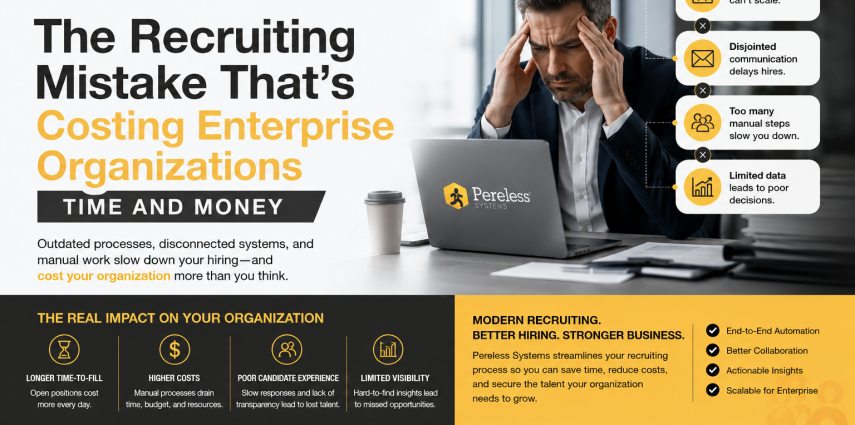
The Recruiting Mistake That’s Costing Enterprise Organizations Time and Money

Enterprise organizations invest heavily in attracting top talent.

Yet many talent acquisition teams still struggle with lengthy hiring cycles, disconnected recruiting processes, communication gaps, and inefficient workflows that slow down hiring and increase costs.

The challenge isn’t a lack of effort.

It’s relying on recruiting processes and technology that weren’t built to support the demands of a modern enterprise workforce.

As competition for talent continues to increase, organizations that fail to modernize their recruiting operations risk losing candidates, reducing productivity, and increasing hiring costs.

The Hidden Cost of Inefficient Recruiting

Every day a position remains open costs your organization money.

Beyond the direct costs of recruiting, delayed hiring impacts:

  • Team productivity
  • Employee workload
  • Revenue generation
  • Customer service
  • Business growth initiatives

When recruiting processes rely on manual tasks, disconnected systems, and inconsistent communication, these costs compound quickly.

The result is often longer time-to-fill metrics, frustrated hiring managers, and missed opportunities to secure top talent.

Common Recruiting Challenges Enterprise Organizations Face

As organizations grow, recruiting becomes increasingly complex.

Many talent acquisition teams encounter challenges such as:

Fragmented Recruiting Processes

Candidate information often lives across multiple systems, emails, spreadsheets, and communication tools.

Without a centralized recruiting platform, visibility and efficiency suffer.

Slow Hiring Decisions

Coordinating feedback between recruiters, hiring managers, department leaders, and executives can create significant delays.

The longer the process takes, the greater the risk of losing qualified candidates.

Inconsistent Candidate Experiences

Today’s candidates expect timely communication and a seamless application process.

Delays, lack of updates, and complicated workflows can negatively impact employer brand and candidate engagement.

Limited Recruiting Visibility

Without robust reporting and analytics, organizations struggle to answer critical questions:

  • Which recruiting sources produce the best hires?
  • How long does it take to fill key positions?
  • Where are hiring bottlenecks occurring?
  • How can recruiting performance be improved?

Data-driven decision-making becomes difficult when information is scattered across systems.

Why Modern Talent Acquisition Requires Enterprise Recruiting Technology

Today’s enterprise hiring environment demands more than basic applicant tracking.

Organizations need recruiting technology that enables:

  • Cross-functional collaboration
  • Automated workflows
  • Candidate engagement
  • Compliance support
  • Advanced reporting and analytics
  • Multi-location recruiting
  • High-volume hiring management

The right platform allows recruiters to spend less time on administrative work and more time building relationships with candidates and hiring managers.

How Pereless Systems Helps Enterprise Organizations Hire Smarter

Pereless Systems provides enterprise organizations with a comprehensive recruiting platform designed to streamline hiring from sourcing to onboarding.

With Pereless Systems, organizations can:

✔ Centralize recruiting operations across teams and locations

✔ Automate candidate communications and workflows

✔ Improve recruiter and hiring manager collaboration

✔ Enhance the candidate experience

✔ Leverage advanced reporting and recruiting analytics

✔ Support compliance and organizational hiring requirements

✔ Manage high-volume and multi-location recruiting initiatives

✔ Reduce administrative burden through automation

By simplifying recruiting operations, organizations can accelerate hiring, improve efficiency, and make better talent decisions.

The Business Impact of Modern Recruiting

Organizations that modernize their recruiting processes often experience:

  • Faster hiring cycles
  • Improved recruiter productivity
  • Better candidate engagement
  • Stronger collaboration across departments
  • Increased visibility into recruiting performance
  • Reduced hiring costs

Most importantly, they position themselves to attract and secure top talent before competitors do.

The Bottom Line

The biggest recruiting mistake many enterprise organizations make isn’t a lack of talent acquisition effort—it’s relying on outdated processes and disconnected systems that create unnecessary friction throughout the hiring journey.

Modern recruiting requires technology that supports efficiency, collaboration, scalability, and data-driven decision-making.

Organizations that invest in optimizing their recruiting operations gain a significant competitive advantage in today’s talent market.

Ready to modernize your recruiting process?

Discover how Pereless Systems helps enterprise organizations streamline hiring, improve efficiency, and attract top talent faster.

Schedule a demo today and see how enterprise recruiting can be simpler, smarter, and more effective.


Why Your Hiring Process Is Costing You Top Talent (And How to Fix It)

In today’s hiring market, speed, communication, and candidate experience matter more than ever. The reality is simple: if your hiring process is slow, manual, or disorganized, you’re likely losing qualified candidates before you even have the chance to make an offer.

For recruiters, hiring managers, and business owners already stretched thin, hiring can quickly become overwhelming. Between reviewing resumes, scheduling interviews, following up with candidates, and coordinating internal feedback, the process often becomes inefficient without the right tools in place.

The good news? These hiring challenges are fixable.

Here’s why your current hiring process may be costing you top talent — and what you can do to improve it.

Common Hiring Bottlenecks That Hurt Recruitment

Many companies don’t realize how many friction points exist within their hiring process until candidates start dropping off or positions remain open for months.

Some of the most common hiring bottlenecks include:

  • Manually reviewing resumes
  • Delayed communication with candidates
  • Interview scheduling back-and-forth
  • Lack of collaboration between hiring teams
  • Disorganized applicant tracking
  • Slow approval processes
  • Posting jobs across multiple platforms manually

These delays create frustration not only for recruiters and hiring managers, but also for candidates who expect a faster and more transparent experience.

If your team is still relying on spreadsheets, email chains, or disconnected systems to manage hiring, chances are your process is costing valuable time — and potentially top applicants.


The Real Cost of a Slow Hiring Process

A slow hiring process doesn’t just impact productivity. It directly affects your ability to compete for talent.

Top candidates are often off the market within days — not weeks.

When communication is delayed or interview scheduling drags on, candidates may:

  • Accept offers elsewhere
  • Lose interest in the role
  • Form negative impressions of your company
  • Stop responding entirely

Beyond losing talent, slow hiring can also lead to:

  • Increased workload for existing employees
  • Higher recruiting costs
  • Lost business opportunities
  • Reduced team morale
  • Longer vacancies impacting operations

For growing businesses, nonprofits, healthcare organizations, hospitality employers, and other fast-moving industries, these delays can become extremely costly.


What Candidates Expect From Employers Today

Today’s candidates expect the hiring experience to feel modern, streamlined, and responsive.

That means:
✔ Easy online applications
✔ Fast communication
✔ Mobile-friendly experiences
✔ Timely interview scheduling
✔ Clear next steps
✔ Consistent follow-up

Candidates are evaluating your company throughout the hiring process — not just during the interview.

If the experience feels confusing, outdated, or slow, candidates may assume your organization operates the same way internally.

A positive candidate experience can help improve:

  • Offer acceptance rates
  • Employer branding
  • Candidate engagement
  • Long-term talent pipelines

Where Companies Lose Applicants Most Often

Many companies unintentionally lose strong candidates during these critical stages:

1. The Application Process

Long or complicated applications often cause candidates to abandon the process before applying.

2. Delayed Follow-Up

Candidates expect acknowledgment and communication quickly after applying.

3. Scheduling Delays

Too much back-and-forth can create frustration and scheduling conflicts.

4. Poor Internal Collaboration

When hiring teams aren’t aligned, feedback and decisions take longer.

5. Lack of Visibility

Without proper tracking, candidates can accidentally fall through the cracks.

These issues are common — but they’re also preventable with the right recruiting technology.


How Automation & AI Improve Hiring

Modern recruiting software and AI-powered applicant tracking systems help organizations simplify and streamline hiring from start to finish.

Instead of spending hours on repetitive administrative tasks, recruiters and hiring teams can focus on building relationships with candidates and making better hiring decisions.

Benefits of Hiring Tools Include:

  • Automated workflows
  • Faster candidate communication
  • Centralized applicant tracking
  • Automated interview scheduling
  • Easier collaboration among hiring teams
  • AI-assisted resume review
  • Improved reporting and analytics
  • Better candidate experiences

Automation helps reduce delays, eliminate manual tasks, and improve efficiency throughout the hiring process.

For enterprise businesses especially, having an easy-to-use recruiting platform can make a significant difference in attracting and retaining top talent.


Simplify Hiring With Pereless Systems

At Pereless Systems, we help enterprise businesses simplify hiring with an applicant tracking system designed to make recruiting faster, easier, and more cost-effective.

Pereless Systems helps organizations:

  • Streamline recruiting workflows
  • Improve candidate communication
  • Reduce time-to-hire
  • Automate manual hiring tasks
  • Create a better hiring experience for both recruiters and applicants

Whether you’re a growing business, recruiter, or hiring manager, Pereless Systems gives your team the tools needed to hire smarter — without the complexity of traditional systems.


Ready to Improve Your Hiring Process?

If your team is struggling with slow hiring, manual processes, or losing candidates to competitors, it may be time to modernize your recruiting strategy.

Discover how Pereless Systems can help you streamline hiring, attract top talent, and simplify recruitment with hiring tools designed for today’s hiring landscape.

Schedule a demo today! https://power.pereless.com/request-a-demo/

Is Your Hiring Process Costing You Top Candidates?

Today’s hiring process is supposed to make recruiting easier. But for many companies, it’s doing the exact opposite.

Candidates are applying, interviewing, and then disappearing. Recruiters are overwhelmed with applications. Hiring managers are frustrated by slow processes and poor-fit candidates. And somewhere in the middle, great talent is getting lost.

The truth is, the hiring problem often isn’t a talent problem — it’s a process problem. (LinkedIn)

At Pereless Systems, we believe hiring should feel simple, human, and efficient for everyone involved.

The Modern Hiring Experience Is Broken

Many hiring teams rely on outdated workflows, disconnected systems, and overly complicated recruiting tools. Candidates often experience:

  • Long application processes
  • Poor communication
  • Confusing interview stages
  • Delayed feedback
  • “Black hole” applications with no response

Research and industry conversations continue to show that candidate experience directly impacts employer brand, engagement, and hiring success. (LinkedIn Business Solutions)

And candidates notice.

In online hiring communities, job seekers consistently describe frustration with slow communication, excessive automation, and hiring systems that feel impersonal or difficult to navigate. (Reddit)

The result? Companies lose qualified candidates before they ever make it to the offer stage.

Complexity Doesn’t Equal Better Hiring

Many ATS platforms promise more features, more automation, and more customization. But for enterprise companies, more complexity often creates more problems.

When recruiting software becomes difficult to implement, manage, or navigate, hiring teams spend more time fighting the system than engaging with candidates.

That’s why Pereless Systems was built differently.

Pereless Systems helps enterprise businesses simplify hiring while staying compliant and organized.

Instead of forcing companies into rigid workflows, Pereless Systems focuses on what hiring teams actually need:

  • Fast setup
  • Easy-to-use workflows
  • Automation without complexity
  • Real-time reporting and visibility
  • Seamless integrations
  • Compliance-focused hiring tools
  • A better experience for recruiters and candidates alike

Because hiring software should support your process — not slow it down.

Candidate Experience Is Now a Competitive Advantage

Today’s candidates evaluate your hiring process the same way customers evaluate your brand.

A slow or frustrating process can damage trust before someone even joins your company. Meanwhile, a streamlined, transparent hiring experience helps companies:

  • Improve candidate engagement
  • Reduce drop-off rates
  • Increase offer acceptance rates
  • Strengthen employer branding
  • Hire faster and more efficiently

According to LinkedIn Talent Solutions, improving candidate experience has become a top priority for hiring teams because it directly impacts recruiting outcomes and long-term hiring success. (LinkedIn Business Solutions)

The companies winning top talent today aren’t necessarily the biggest companies.

They’re the companies creating the best hiring experiences.

Simplify Hiring Without Sacrificing Compliance

For enterprise organizations, staying compliant while moving quickly can feel challenging.

Pereless Systems helps simplify that balance by giving hiring teams structured workflows, centralized candidate tracking, and tools designed to support organized, compliant hiring practices — without adding unnecessary complexity.

The goal isn’t to automate people out of the process.

The goal is to remove friction so recruiters and hiring managers can focus on what matters most: building relationships and hiring great people.

The Future of Hiring Is Simpler

Hiring doesn’t need to feel overwhelming.

The right ATS should help your team move faster, stay compliant, improve candidate experience, and make smarter hiring decisions — all while remaining easy to use.

That’s the Pereless Systems difference.

Simple. Streamlined. Built for enterprise teams.

Learn more about how Pereless Systems can help simplify your hiring process: Power.pereless.com

🚀 Experience Pereless Systems

Ready to simplify hiring while staying compliant? Book a free demo today to see Pereless Systems in action! Power.pereless.com

The Future of Applicant Tracking Systems: ATS Trends Recruiters Need to Know in 2026

In today’s competitive hiring landscape, having a fast, efficient, and smart recruiting process isn’t just an advantage — it’s essential. As we enter 2026, Applicant Tracking Systems (ATS) are rapidly evolving from simple resume funnels into intelligent talent ecosystems that empower recruiters to attract, evaluate, and hire top performers faster than ever before.

Whether you’re a hiring manager, HR leader, or talent acquisition pro, understanding the future of ATS can elevate your recruiting strategy and help you stay ahead of the curve. Here’s what modern recruiters need to know.

1. AI-Driven Recruiting Is the New Standard

Gone are the days when an ATS simply stored resumes. In 2026, the most powerful systems now integrate AI at every step of the hiring process.

How AI is changing recruiting:

  • Automated candidate screening and ranking

  • Predictive analytics that forecast candidate success

  • Natural language processing for smarter job matching

  • AI chatbots that engage candidates 24/7

Today’s ATS doesn’t just store data — it interprets it, highlights insights, and helps you make decisions faster and more accurately.

2. Candidate Experience Takes Center Stage

High-quality talent expects a seamless and engaging application experience. In 2026, ATS platforms are prioritizing mobile-friendly, intuitive workflows that simplify the candidate journey from application to offer.

Key candidate experience enhancements:

  • Branded and mobile-friendly career pages

  • Quick apply options

  • Real-time status updates

  • AI-powered communication and feedback

A smoother candidate experience doesn’t just improve your brand — it drives better talent conversion and reduces drop-offs.

3. Deep Automation Means More Time for Strategy

One of the biggest headaches in recruiting has always been administrative tasks — manual emails, interview scheduling, resume sorting, and more. In 2026, advanced ATS platforms eliminate repetitive work through automation pipelines that think for you.

Examples include:

  • Automated interview scheduling synced with calendars

  • Drip email campaigns tailored to candidate status

  • Auto-tagging and categorization of candidate profiles

  • Workflow triggers based on recruitment milestones

With these systems handling the “busy work,” recruiters can focus on what they do best: building relationships and strategic hiring plans.

4. Integration with HR Tech Ecosystems

Recruiting doesn’t happen in isolation. Today’s ATS must play well with other HR tools — like payroll, onboarding, performance management, and HRIS platforms.

In 2026, ATS systems that offer:
✔ Native integrations
✔ Open APIs
✔ Unified data dashboards
will be invaluable for creating seamless HR operations and real-time workforce insights.

This connected ecosystem empowers firms to move from reactive hiring to data-driven talent planning.

5. Real-Time Analytics and Predictive Insights

Data has become a compass for better decisions — and modern ATS systems are delivering analytics that matter.

Recruiters can now track:

  • Time-to-hire trends

  • Diversity hiring performance

  • Source effectiveness

  • Candidate journey bottlenecks

Beyond reporting, predictive analytics help you see what’s coming next — from forecasting hiring needs to identifying positions at risk of lingering open.

6. Smarter Scalability for Growing Teams

Whether you’re a startup ready to hire your first employees or an enterprise filling hundreds of roles, 2026 ATS solutions are modular and scalable — meaning you only pay for what you need, when you need it.

Scalable ATS systems:

  • Support growth without costly over-engineering

  • Allow feature layering as teams expand

  • Offer flexible pricing models

This helps organizations manage recruiting costs without sacrificing capability.

Bradford’s Takeaway: The ATS Advantage in 2026

The future of applicant tracking systems isn’t about simply tracking applicants — it’s about empowering recruiters with intelligent, data-driven tools that streamline hiring, elevate candidate experience, and drive strategic decisions.

In 2026, the ATS isn’t just another platform in your HR stack — it’s the central engine powering modern talent acquisition.

If your recruiting software feels outdated, clunky, or inefficient, now is the time to explore next-generation ATS solutions that bring:
📌 AI automation
📌 Real-time analytics
📌 Seamless workflows
📌 Scalable features
📌 Better experiences for both recruiters and candidates

The future of hiring is here — and it starts with a smarter ATS.

Ready to attract top talent like a pro? Book a free demo today!

Pereless Systems: Affordable, enterprise ATS for teams that hire to thrive.

Top 4 Ways HR Professionals Can Stay Ahead of ATS Trends and Technology

In the fast-moving world of talent acquisition, staying current with the latest Applicant Tracking System (ATS) trends and technologies is no longer optional—it’s essential. Advances like AI in hiring, automation, and the rise of remote/hybrid work models are reshaping how HR professionals source, engage, and hire top talent. For HR teams striving to improve the candidate experience and deploy smarter HR technology, keeping pace with innovation ensures a competitive edge in both recruitment efficiency and quality.

Embrace the Power of AI in Hiring and Automation

Artificial Intelligence is revolutionizing recruitment by automating repetitive tasks such as resume screening, interview scheduling, and candidate assessments. HR pros who stay informed about emerging AI capabilities within ATS platforms can streamline hiring processes, reduce unconscious bias, and identify top talent faster. For HR pros, understanding how to leverage AI in hiring means less time sifting through piles of resumes and more time focusing on meaningful candidate interactions. Following industry blogs, attending AI-focused webinars, and participating in technology demos can help HR professionals recognize which tools offer the best integration of AI for their needs.

Automation goes hand in hand with AI in elevating the efficiency of HR teams. From automated workflows that push candidate data to various stages, to AI-powered chatbots that communicate with job applicants, automation ensures a seamless experience for both recruiters and candidates alike. Keeping pace with the latest automation functionalities means HR pros can provide a personalized, responsive candidate experience while saving time and reducing human error.

Adapt to Remote and Hybrid Work Models

The pandemic fundamentally changed the nature of work, making remote and hybrid work models the new normal. ATS technologies have responded by integrating features that support virtual interviews, remote onboarding, and seamless collaboration across distributed teams.

HR professionals need to remain attuned to how ATS platforms evolve to meet these changing hire-and-work dynamics. Engaging with industry thought leadership, networking groups, and peers focusing on remote work technology provides insights into best practices and new tools tailored to distributed hiring environments. This ensures that recruitment processes remain smooth and efficient regardless of physical location.

Focus on Improving the Candidate Experience

In today’s competitive talent market, the candidate experience can make or break your recruitment success. Smarter HR technology not only helps recruiters but also significantly improves the candidate experience. Features like intuitive application portals, real-time status updates, and AI-driven communication foster transparency and engagement. HR pros should explore ATS updates that enhance mobile accessibility and incorporate candidate feedback mechanisms to continuously refine their recruitment approach. Staying updated on ATS innovations focused on user experience helps HR pros ensure every applicant feels valued and informed throughout the hiring process.

Leverage Continuous Learning and Industry Engagement

To stay ahead of evolving ATS trends, HR professionals must commit to continuous education. Subscribing to industry newsletters, participating in HR technology conferences, enrolling in relevant training, and joining professional networks help maintain an up-to-date knowledge base.

Hands-on experimentation, such as pilot testing new features or collaborating with HR tech providers for demos, brings applied understanding that complements theoretical learning. Staying actively involved in the HR tech community enables professionals to exchange ideas, share challenges, and discover practical solutions to common hiring hurdles.

Bradford’s Takeaway

For HR professionals, staying current with the latest ATS trends and technologies is pivotal in harnessing the potential of AI in hiring, automation, and solutions built for remote/hybrid work models. By embracing smarter HR technology and continually focusing on improving the candidate experience, HR teams can drive efficiency, reduce bias, and build stronger talent pipelines.


The key to success lies in ongoing learning, active industry participation, and a proactive approach to adopting innovations. In doing so, HR pros ensure their organizations remain competitive while creating recruitment processes that are as dynamic and flexible as the workforce they seek to attract. Keeping up with ATS advancements doesn’t just streamline hiring — it transforms it.

Recruiting Software Automation: Free Up Your Time to Focus on Candidates

In today’s fast-paced hiring landscape, recruiters are facing more pressure than ever to identify, engage, and hire top talent—quickly and efficiently. But the reality is that much of their time is consumed by administrative tasks: sorting resumes, scheduling interviews, sending follow-ups, and managing data across platforms. That’s where recruiting software automation comes in—not just as a trend, but as a powerful tool to transform your hiring workflow.

Why Recruiters Need Automation

Recruiting is about people. But ironically, the daily workload often pulls recruiters away from human connection. According to industry surveys, recruiters can spend up to 60% of their time on repetitive administrative work. This is time that could be better spent on:

  • Building relationships with candidates 
  • Collaborating with hiring managers 
  • Enhancing employer branding 
  • Delivering a more personalized candidate experience 

Recruiting software automation helps to bridge that gap. By handling the busywork, it frees you to focus on what really matters—people.

What Can Be Automated?

Modern recruitment software can handle a wide array of tasks, from the first job post to the final offer letter. Here are some of the key areas where automation adds value:

1. Pre-Screening Questions

Applicant tracking systems (ATS) can sift through hundreds of resumes in seconds, by sorting candidates to their desired recruit flow based on their responses to pre-screening questions on the application. No more manually reading through each resume—you get a shortlist of the most qualified candidates instantly.

2. Interview Scheduling

Automated scheduling tools sync with your calendar and allow candidates to choose from available time slots. This eliminates the back-and-forth emails and reduces scheduling errors.

3. Candidate Communication

From follow-up emails to status updates, automation tools can send personalized messages at key stages of the hiring process, ensuring candidates are never left in the dark.

4. Job Postings

Recruiting platforms can distribute your job listing across multiple job boards and social media platforms simultaneously, ensuring broader reach without extra work.

5. Reporting and Analytics

Automated dashboards provide real-time insights into your hiring funnel, helping you make data-driven decisions to improve speed, quality, and diversity of hires.

Choosing the Right Recruiting Software

When selecting an automation tool, look for features that align with your team’s needs. Key considerations include:

  • Ease of integration with existing HR tools 
  • User-friendly interface for both recruiters and candidates 
  • Customization to reflect your unique hiring process 
  • Scalability as your organization grows

Popular tools in the market include our recruiting software Pereless Systems, offering a variety of levels of automation and flexibility.

Bradford’s Takeaway:

Recruiting software automation isn’t about replacing recruiters—it’s about empowering them. By reducing time spent on repetitive tasks, automation allows you to invest more energy into what really matters: building relationships, understanding candidate motivations, and finding the perfect match for your organization.

In a world where talent is the true competitive advantage, your time is your most valuable resource. Let automation take care of the routine so you can focus more on your business and finding remarkable talent.

Top 5 Common Hiring Challenges for Franchise Owners

In the fast-paced world of franchising, attracting and retaining the right talent is essential for success. However, franchise owners often face unique hiring challenges—from managing multiple locations to maintaining consistent standards across their teams. Thankfully, recruiting software has emerged as a powerful tool that helps franchise owners streamline their hiring processes and find the best candidates efficiently. In this blog post, we’ll explore how recruiting software addresses common hiring obstacles in franchising and why it’s a must-have for franchise owners.

Understanding Common Hiring Challenges for Franchise Owners

Franchise businesses operate differently than standalone companies. With multiple outlets, each location may have unique staffing needs, but maintaining a consistent hiring standard is critical. Some typical hiring challenges faced by franchise owners include:

Managing High Volume of Applicants: Multiple franchise locations mean a large pool of candidates, which can be overwhelming to sort through manually.

Ensuring Consistency: Hiring standards must be uniform across all locations to uphold brand reputation.

Time Constraints: Franchise owners and managers are often juggling day-to-day operations, leaving limited time for recruitment.

Compliance and Documentation: Handling legal and compliance requirements for employment across different regions can be complex.

Candidate Engagement: Keeping potential hires engaged during the recruitment process is crucial to prevent drop-offs.

How Recruiting Software Transforms the Franchise Hiring Process

Recruiting software simplifies and automates many aspects of hiring, specifically tailored to overcome the challenges faced by franchise owners.

  1. Centralized Applicant Tracking for Multiple Locations

Recruiting software provides a centralized platform where franchise owners can manage applications from various outlets seamlessly. This centralization allows hiring managers to filter applicants based on location, role, and qualifications, improving efficiency and reducing administrative burdens.

  1. Standardized Hiring Workflows

Consistency is key in franchising. Recruiting software enables franchise owners to create standardized hiring workflows, including uniform job descriptions, screening criteria, and interview processes. This ensures every location applies the same rigorous standards to their candidate selection.

  1. Automated Communication and Scheduling

The software automates candidate communication—sending interview invites, reminders, and status updates—which keeps applicants engaged throughout the hiring cycle. Automation also frees up time for managers to focus on operational priorities without neglecting recruitment.

  1. Compliance Management

Recruiting platforms often include features that help track documentation and ensure compliance with employment laws across regions. This reduces the risk of legal issues and simplifies record-keeping for franchise owners.

  1. Data-Driven Hiring Decisions

Recruiting software provides analytics and reporting tools that offer insights into recruitment metrics such as time-to-hire, source of hire, and candidate quality. Franchise owners can use this data to continuously improve their hiring strategies and make informed decisions.

Why Franchise Owners Should Invest in Recruiting Software

Investing in the right recruiting software offers franchise owners a competitive edge in talent acquisition. By overcoming common hiring challenges, franchise businesses can reduce turnover, improve team quality, and ultimately enhance overall customer experience. Moreover, streamlined recruitment processes lead to cost savings and faster onboarding, enabling franchises to grow more efficiently.

Key Takeaway

Recruiting software is no longer a luxury but a necessity for franchise owners aiming to conquer the complex world of multi-location hiring. From centralizing applicant tracking to enforcing standardized workflows and ensuring compliance, this technology empowers franchise businesses to attract, engage, and retain top talent with ease. If you’re a franchise owner looking to optimize your hiring process and build stronger teams, integrating recruiting software could be the game-changing solution you need.

How Automation Can Help Franchise Owners Save Time Hiring

Running a food franchise is relentless. Between managing operations, tracking inventory, resolving customer complaints, and keeping the business humming, hiring can feel like a never-ending burden. If you’re a franchise owner, how many hours did you or your managers spend this week sifting through resumes or chasing down interview confirmations? If that number makes you wince, it’s time to rethink your approach with automation.

The Hidden Cost of Manual Hiring

Let’s face it: hiring is packed with repetitive, time-consuming tasks. Posting the same job ad across multiple platforms, playing email tag to schedule interviews, following up with no-shows, or sorting through a pile of applications to find qualified candidates—these chores add up. For many franchise owners, these tasks eat up hours that could be better spent training staff, improving operations, or simply catching a breather.

The stakes are high in a fast-paced industry like food service. Manual hiring processes aren’t just tedious—they’re a bottleneck. They slow down your ability to fill roles, increase the risk of errors, and leave you understaffed during critical times. Meanwhile, your competitors are adopting smarter tools to stay ahead.

Enter Hiring Automation: A Game-Changer for Franchises

Modern hiring automation isn’t a futuristic dream—it’s here, and it’s transforming how franchises operate. Take the example of one franchisee who slashed their weekly hiring time from 6-8 hours to just 20 minutes by automating 75% of the process (smarterwaytohire.com). That’s nearly a full workday reclaimed every week! Imagine what your team could do with that kind of time back—focus on customer experience, refine operations, or even take a well-deserved break.

Here’s how automation can revolutionize your hiring process:

1. Auto-Screening Applicants

No more wading through stacks of unqualified resumes. With an Applicant Tracking System (ATS), you can set specific criteria—like availability, certifications, or experience—and let the system filter out unsuitable candidates. You’ll instantly see the best applicants, saving hours of manual review.

2. Instant Interview Scheduling

Say goodbye to endless back-and-forth emails. Candidates receive a link to self-schedule interviews based on your pre-approved time slots. The system fills your calendar automatically, sends confirmations, and even handles reminders, making the process seamless for everyone.

3. Bulk Actions & Templates

Need to send rejection emails to multiple candidates? Write the message once, send it to all with a single click, and you’re done. Have a job opening across 10 locations? Use job templates to post jobs in minutes, ensuring consistency and saving time.

Why Automation Matters for Franchises

By automating repetitive tasks, you free your managers to focus on what humans do best: connecting with people. Instead of drowning in paperwork, they can dedicate time to interviewing top candidates (pre-screened by the ATS) and onboarding new hires with a warm welcome. This not only improves the hiring experience but also sets the stage for better employee retention.

The alternative—sticking with manual processes—comes with a steep cost. Wasted hours, delayed hires, and missed opportunities can leave your franchise understaffed and overworked. In an industry where speed and efficiency are everything, falling behind on tech means falling behind on talent.

Hire Smarter with a Franchise-Focused ATS

Our ATS is designed specifically for franchises, acting like an extra hiring assistant that works 24/7 at every location. It streamlines the entire process, from posting jobs to onboarding, so you can fill roles faster and get back to running your business.

Bradford’s Key Takeaway


In today’s fast-paced franchise landscape, automation isn’t just a luxury—it’s a game-changer. By streamlining hiring processes, reducing human error, and accelerating candidate selection, automation empowers franchise owners to build stronger teams faster and smarter. Embracing this technology isn’t optional; it’s essential for those who want to stay competitive, scalable, and successful. The future of franchise hiring is automated—will you lead the transformation or be left behind?


Ready to reclaim your time and hire smarter? Book a demo today and see how automation can save hours, reduce stress, and keep your franchise fully staffed.

Proven Sales Strategies to Thrive in Today’s Market

The sales landscape is constantly evolving, driven by technology, consumer behavior changes, and market trends. In 2025, businesses face the challenge of keeping up with these shifts while ensuring their sales strategies remain effective and sustainable. To thrive in this dynamic environment, organizations must adapt to new tools, techniques, and mindsets. Below are key strategies to navigate today’s sales landscape and position your business for success.

1. Leverage Data and Analytics

In the modern sales environment, data is king. Sales teams are increasingly using data analytics to make informed decisions and predict customer behavior. By analyzing data from past sales, customer interactions, and digital marketing efforts, businesses can identify trends, optimize sales processes, and forecast future outcomes with greater accuracy.

2. Embrace AI and Automation

Artificial Intelligence (AI) and automation are transforming the way sales teams operate. From chatbots to email marketing automation, AI can help streamline repetitive tasks, personalize customer communication, and improve lead scoring. This allows your sales team to focus on high-value activities like building relationships and closing deals.

3. Focus on Relationship Building

In a world of increasing digital communication, personal relationships are more valuable than ever. Buyers are looking for trust, empathy, and value in their interactions with businesses. Salespeople must focus on building authentic relationships and offering solutions that genuinely help their clients, rather than simply pushing for a sale.

4. Adapt to Hybrid Selling Models

The pandemic accelerated the shift toward remote work and digital communication, but hybrid models (a mix of in-person and online interactions) have remained prominent in the post-pandemic world. Sales teams must adapt to selling in both virtual and physical spaces. Virtual meetings, webinars, and video calls are now essential tools in the sales process.

5. Prioritize Customer Experience

Customer experience (CX) has become the top differentiator in the sales process. Buyers now expect seamless, fast, and personalized experiences across all touchpoints. Businesses that provide exceptional CX will build long-term customer loyalty and increase sales opportunities through referrals.

6. Train and Empower Your Sales Team

A well-trained, motivated sales team is essential for success in any sales landscape. Equip your team with ongoing training on the latest sales techniques, tools, and industry trends. Encourage continuous learning and provide resources that empower them to be successful.

7. Use Social Selling to Your Advantage

Social selling is the process of using social media to connect with prospects and build relationships. Platforms like LinkedIn, Twitter, and Instagram provide invaluable opportunities for salespeople to share insights, engage in meaningful conversations, and position themselves as thought leaders in their industry.

8. Adapt Your Messaging for Modern Buyers

Today’s buyers are more informed than ever. With easy access to information online, many buyers conduct extensive research before they ever reach out to a salesperson. As a result, it’s essential that your messaging resonates with modern buyers and positions your product or service as the solution to their problem.

9. Embrace the Power of Referrals and Testimonials

In an age of skepticism, referrals and testimonials have become one of the most trusted forms of marketing. Positive word-of-mouth from existing customers can go a long way in convincing new prospects to make a purchase.

10. Be Agile and Flexible

The sales landscape is constantly changing, and businesses must be able to pivot quickly. Whether it’s shifting market conditions, evolving customer preferences, or unexpected disruptions, agility is key to staying competitive.

Navigating today’s sales landscape requires a mix of technology, strategy, and human touch. By embracing data, AI, and automation while focusing on relationship-building and personalized experiences, businesses can adapt to the modern sales environment. A well-trained sales team empowered with the right tools will be better positioned to drive success and achieve long-term growth in this fast-paced and ever-changing market. Stay proactive, flexible, and always look for ways to improve your sales strategy. Success in today’s landscape isn’t just about making a sale – it’s about building lasting relationships that keep customers coming back.

What Would Bradford Do?


Bradford’s Key Takeaway:

To succeed in today’s rapidly changing sales landscape, businesses must embrace a combination of cutting-edge tools and customer-centric approaches. Data and AI should be used to streamline processes and provide personalized experiences, while relationship-building remains at the core of sales success. By focusing on continuous learning, adapting to hybrid models, and delivering exceptional customer experiences, businesses can position themselves for long-term growth and resilience. 

Queue or Bot? The Ultimate Debate on Customer Service in the Age of AI

In the digital age, customer service has evolved dramatically. What used to be a simple phone call to a representative has now transformed into a variety of options—some more convenient than others, and some more frustrating. Whether you find yourself waiting for minutes—or even hours—in a queue or speaking with an AI bot that doesn’t quite understand your request, customer service has become a mixed experience for many.

But what does the future hold? Should we accept long waits as a norm, or are AI bots truly the solution? Let’s explore the pros and cons of each, and what customers really want from customer service today.

The Queue: A Dying Tradition or Necessary Evil?

Remember the days of calling a customer service number, only to be greeted by an automated message: “Your estimated wait time is 20 minutes”? It’s a scenario that nearly everyone has faced at some point. While queues have been a staple of traditional customer service, they come with significant downsides.

The Frustrations of Waiting

The biggest issue with queues is simply the wait. Long wait times can be incredibly frustrating, especially when your issue is time-sensitive. It often feels like your time is being wasted. And as the wait drags on, customers are left with nothing to do but listen to repetitive hold music or, worse, a never-ending loop of disclaimers.

The Call Center Dilemma

Customer service teams at call centers are often understaffed or overwhelmed by the volume of requests, which exacerbates the wait times. While most companies try to improve response times, it’s not always feasible to staff enough agents to meet the high demand, especially during peak periods or after hours.

However, some organizations are finding innovative ways to improve the queue experience. Offering a callback service, where a representative will return your call at a later time, can reduce the pressure of waiting on hold for hours. This method, although not perfect, helps balance customer service expectations with resource limitations.

AI Bots: The Rise of Automation

As businesses strive to improve the customer service experience, AI bots have become an increasingly common solution. These bots are designed to handle a wide variety of queries—often with quick responses and without the need for human intervention. AI bots can be found on websites, within apps, or integrated into social media platforms.

The Benefits of AI Bots

  1. Instantaneous Response: One of the most significant benefits of AI bots is that they can provide an immediate response. If you need basic assistance or have a simple question, bots are able to respond instantly, eliminating the need to wait in long queues.
  2. 24/7 Availability: Unlike human representatives who work within specific hours, AI bots can be available around the clock. This is particularly beneficial for businesses that operate internationally or in industries where customers expect assistance outside traditional working hours.
  3. Efficiency for Repetitive Queries: AI bots excel at handling routine inquiries. If your question is common, like “Where is my order?” or “What are your business hours?”, the bot can instantly provide the answer. This frees up human agents to handle more complex, unique, or sensitive issues.
  4. Reduced Human Error: AI bots don’t have the fatigue or human errors that may come from a long shift. They can give consistent and accurate responses based on the data they’re programmed with.

The Downsides of AI Bots

While AI bots have made customer service more accessible, they’re far from perfect. Many customers feel frustrated when bots don’t understand their questions or give irrelevant answers. For complex issues, the impersonal nature of AI can make interactions feel cold and robotic—literally.

Additionally, AI bots have limited empathy. A bot might give a factual answer to your problem, but it cannot console you if your issue is more emotionally charged or requires nuanced understanding.

For many people, the frustration with bots comes when they cannot solve the issue or when they “escalate” you to a human representative—who may ask you to repeat everything you just told the bot. In those cases, customers feel like they’re wasting time and energy.

What Do Customers Really Want?

So, what do customers truly want from customer service? The answer is clear: convenience, efficiency, and empathy.

  • Convenience means not having to wait in a long queue or be forced to navigate endless chatbot scripts.
  • Efficiency means getting the right answer or solution quickly, whether through an AI bot or human representative.
  • Empathy means being understood as a human, especially when the issue is complicated, urgent, or sensitive.

There is no one-size-fits-all answer when it comes to customer service. While many appreciate the speed of AI bots for quick queries, others prefer the reassurance of speaking to a human who can understand the nuances of their issue.

Striking the Balance: AI Bots + Human Agents

The ideal solution for most customers lies in a hybrid model. AI bots can handle the repetitive, time-sensitive tasks, leaving human agents to focus on more complex issues that require empathy and problem-solving skills. This system allows customers to be routed to the right place, faster, while maintaining the personal touch when necessary.

For example, companies like Amazon and federal banks use AI bots for basic inquiries, like order status or account information, but have human representatives available to deal with specific, complicated, or emotional issues.

Looking Ahead

As artificial intelligence continues to improve, it’s likely that customer service will continue to rely on AI bots, but the human element will never be fully replaced. Instead, the two will coexist—AI will help optimize customer service by making routine interactions more efficient, and humans will step in when expertise and empathy are needed.

Ultimately, the best customer service will be a blend of technology and human care—one that listens, understands, and responds swiftly and effectively to every customer’s needs.