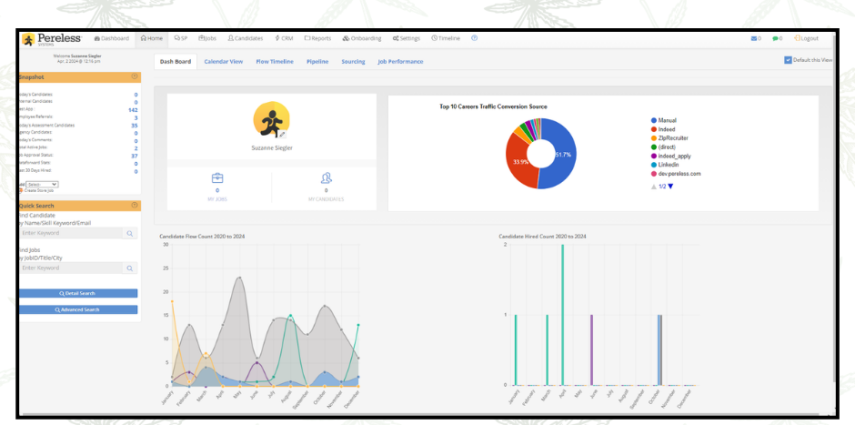
Enterprise Cannabis Recruiting Software: How Pereless Systems Simplifies Hiring in a Complex Industry

The cannabis industry isn’t just growing—it’s evolving under intense regulation, scrutiny, and operational pressure.

A recent reflection on five years of progress from New Jersey regulators highlights a clear shift: cannabis businesses are now expected to operate with greater accountability, transparency, and structure than ever before.

For hiring teams, that changes everything.

If you’re still relying on spreadsheets, inboxes, or disconnected tools to manage hiring, you’re not just inefficient—you’re exposed.

Here’s what’s changing—and how the right applicant tracking system (ATS) keeps you ahead.

Compliance Is Now Built Into Every Hire

Cannabis isn’t like other industries. Every decision—especially hiring—needs to stand up to scrutiny.

From documentation to fair hiring practices, regulators expect consistency and accountability.

The challenge: Manual hiring processes make it nearly impossible to track decisions, maintain records, and ensure compliance across roles and locations.

How Pereless Systems solves it:

  • Centralized candidate records
  • Built-in audit trails for every hiring decision
  • Standardized workflows that reduce risk

Bottom line: You don’t just need to hire—you need to prove you hired correctly.

Growth Is Outpacing Hiring Teams

With billions in sales and continued expansion across markets like New Jersey, cannabis operators are scaling fast.

That means one thing: more applicants, more roles, and more pressure to hire quickly.

The challenge: High-volume hiring overwhelms teams without automation.

How Pereless Systems solves it:

  • Automated candidate screening
  • Built-in messaging (SMS + email)
  • Streamlined workflows to move candidates faster

Bottom line: Speed matters—but not at the expense of quality or compliance.

Multiple Licenses = Multiple Hiring Workflows

Cannabis operators often manage a mix of:

  • Retail locations
  • Cultivation facilities
  • Manufacturing operations

Each comes with different roles, requirements, and compliance expectations.

The challenge: Disconnected hiring processes create confusion, inconsistency, and risk.

How Pereless Systems solves it:

  • Custom workflows by role or location
  • Centralized hiring across all entities
  • Role-specific documentation and requirements

Bottom line: One-size-fits-all hiring doesn’t work in cannabis.

Equity and Fair Hiring Are Under the Microscope

Regulators are placing a strong emphasis on equitable hiring practices.

That means businesses must demonstrate fairness—not just claim it.

The challenge:
Unstructured hiring leads to inconsistent decisions and potential bias.

How Pereless Systems solves it:

  • Structured interview processes
  • Candidate scoring and evaluation tools
  • Consistent workflows across all applicants

Bottom line: Fair hiring isn’t optional—it’s expected.

Transparency Is the New Standard

Cannabis businesses are expected to operate with full visibility—internally and externally.

Hiring is no exception.

The challenge:
Without clear reporting, teams lack insight into hiring performance and compliance.

How Pereless Systems solves it:

  • Real-time hiring dashboards
  • Full candidate lifecycle tracking
  • Reporting for leadership and compliance needs

Bottom line: If you can’t track it, you can’t defend it.

Why This Matters Now

The cannabis industry has officially entered its next phase—structured growth.

Operators who invest in scalable, compliant hiring infrastructure now will:

  • Reduce risk
  • Hire faster
  • Stay ahead of regulatory pressure
  • Build stronger, more consistent teams

Those who don’t will struggle to keep up.

The Pereless Systems Advantage

Pereless Systems is built specifically for high-growth, highly regulated industries like cannabis.

That means you get:

  • A fully structured, audit-ready hiring system
  • Automation that reduces manual work
  • Tools designed to support compliance and scale

All in one platform.

Bradford’s Takeaway

Cannabis hiring isn’t just about filling roles anymore.

It’s about building a process that can withstand growth, regulation, and scrutiny—all at once.

Pereless Systems gives you the system to do exactly that.

🚀 Experience Pereless Systems

Ready to simplify hiring while staying compliant? Book your free demo today to see Pereless Systems in action! https://power.pereless.com/request-a-demo/


Top 8 Reasons Why Business Owners Need Enterprise Recruiting Software

Hiring at the enterprise level isn’t just about filling roles—it’s about managing complexity at scale.

From high applicant volumes to multi-location hiring and compliance requirements, large organizations face challenges that manual processes and basic tools simply can’t handle.

That’s why more organizations are investing in enterprise recruiting software (ATS) like Pereless Systems.

In this guide, we’ll break down the top reasons you need an enterprise ATS and the key benefits it delivers for large, growing teams.


🚀 What Is Enterprise Recruiting Software?

An enterprise Applicant Tracking System (ATS) is a comprehensive recruiting platform designed to help large organizations manage complex hiring processes across departments, locations, and teams.

Unlike basic ATS solutions, enterprise platforms like Pereless Systems offer:

  • Advanced workflow automation
  • High-volume candidate management
  • Customization and integrations
  • Robust reporting and compliance tools

🔑 Top Reasons You Need an Enterprise ATS

1. Manage High-Volume Hiring Efficiently

Enterprise organizations often receive hundreds—or thousands—of applications per role.

Without a centralized system, this quickly becomes overwhelming.

Pereless Systems enables you to:

  • Automatically organize and filter candidates
  • Manage large applicant pools with ease
  • Prioritize top talent quickly

👉 Benefit: Efficient handling of high-volume recruiting without bottlenecks


2. Standardize Hiring Across Teams and Locations

Consistency is critical in enterprise hiring.

With multiple departments and locations involved, processes can become fragmented.

Pereless Systems allows you to:

  • Create standardized workflows
  • Ensure consistent hiring practices
  • Maintain alignment across teams

👉 Benefit: Improved collaboration and process consistency


3. Improve Compliance and Reduce Risk

Enterprise hiring often involves strict compliance requirements, including:

  • Equal Employment Opportunity (EEO)
  • Data privacy regulations
  • Audit readiness

An enterprise ATS helps ensure:

  • Proper documentation
  • Consistent processes
  • Secure data handling

👉 Benefit: Reduced compliance risk and improved accountability


4. Enhance Recruiter Productivity

Manual recruiting tasks don’t scale.

With Pereless Systems, recruiters can:

  • Automate repetitive tasks
  • Focus on high-value activities
  • Spend more time engaging candidates

👉 Benefit: Increased productivity across recruiting teams


5. Gain Visibility with Advanced Reporting

Data-driven hiring is essential for enterprise success.

Pereless Systems provides:

  • Real-time analytics
  • Custom reporting dashboards
  • Insights into hiring performance

👉 Benefit: Better decision-making with actionable insights


6. Improve Candidate Experience at Scale

A poor candidate experience can damage your employer brand.

With enterprise recruiting software, you can:

  • Streamline communication
  • Reduce delays
  • Create a consistent application experience

👉 Benefit: Stronger employer brand and higher candidate satisfaction


7. Integrate with Your HR Tech Stack

Enterprise organizations rely on multiple systems:

  • HRIS
  • Payroll
  • Background checks
  • Job boards

Pereless Systems integrates seamlessly with your existing tools, creating a connected hiring ecosystem.

👉 Benefit: Improved efficiency and reduced data silos


8. Scale Your Hiring as Your Business Grows

Growth brings complexity.

An enterprise ATS ensures your recruiting process can scale without breaking.

With Pereless Systems, you can:

  • Support expansion into new locations
  • Manage increased hiring demand
  • Adapt workflows as needed

👉 Benefit: Future-proof recruiting operations


🎯 Why Choose Pereless Systems for Enterprise Recruiting?

Not all ATS platforms are built for enterprise needs.

Pereless Systems stands out by offering:

  • Scalable, enterprise-ready infrastructure
  • Flexible and customizable workflows
  • Powerful automation and reporting tools
  • Seamless integrations with existing systems
  • User-friendly experience for recruiters and hiring managers

Whether you’re managing thousands of applicants or coordinating hiring across multiple regions, Pereless Systems is built to simplify complexity and drive results.


🧠 The Bottom Line: Do You Need Enterprise Recruiting Software?

If your organization is dealing with:

  • High applicant volume
  • Multiple hiring teams or locations
  • Compliance requirements
  • Inefficient or manual processes

Then an enterprise ATS is no longer optional—it’s essential.

And with the right platform, like Pereless Systems, you can transform recruiting from a challenge into a competitive advantage.


📣 Ready to Elevate Your Enterprise Hiring?

If you’re ready to streamline operations, improve efficiency, and scale your hiring process, it’s time to explore what Pereless Systems can do.

👉 Learn more about Pereless Systems: https://power.pereless.com/request-a-demo/

Mastering Your Applicant Tracking System in 2026: A Complete Guide

Hiring in 2026 is faster, more data-driven, and more candidate-centric than ever before—and your Applicant Tracking System (ATS) sits at the center of it all. What was once a simple resume repository is now a powerful recruiting engine powered by AI, automation, and analytics.

Yet many organizations still underuse their ATS, missing out on efficiencies, insights, and better hires.

This complete guide will show you how to master your ATS in 2026, optimize it for modern recruiting demands, and turn it into a competitive advantage.


What Is an ATS in 2026? (And Why It’s No Longer “Just Software”)

An Applicant Tracking System in 2026 is far more than a hiring database. Modern ATS platforms now support:

  • AI-assisted candidate screening
  • Skills-based and predictive hiring
  • Automated workflows and communications
  • DEI and compliance reporting
  • Deep recruiting analytics and integrations

In short, your ATS is no longer a backend tool—it’s the operating system for your hiring strategy.


Why Mastering Your ATS Matters More Than Ever

Recruiting teams face tighter labor markets, higher candidate expectations, and increasing compliance requirements. A poorly configured ATS can lead to:

  • Longer time-to-hire
  • Missed qualified candidates
  • Poor candidate experience
  • Inaccurate or unusable hiring data

On the flip side, a well-optimized ATS helps you:

  • Hire faster without sacrificing quality
  • Improve recruiter productivity
  • Deliver a seamless candidate journey
  • Make smarter, data-backed hiring decisions

Key ATS Trends Shaping Recruiting in 2026

To master your ATS, you need to align it with where recruiting is heading.

1. AI-Powered Screening (With Human Oversight)

AI now assists with resume matching, skills inference, and candidate prioritization—but ethical use and human review remain critical.

2. Skills-Based Hiring Over Job Titles

Modern ATS platforms emphasize skills, competencies, and potential, not just past roles or degrees.

3. Candidate Experience as a Ranking Factor

Mobile-first applications, fast feedback, and transparent communication directly impact employer brand and acceptance rates.

4. Data Privacy and Compliance by Design

Global data regulations mean ATS systems must offer secure data handling, audit trails, and consent management.


How to Optimize Your ATS Step by Step

Step 1: Audit Your Current ATS Setup

Start by answering:

  • Are workflows standardized or inconsistent?
  • Which features go unused?
  • Where do recruiters rely on manual workarounds?

An ATS audit often reveals quick wins.


Step 2: Configure Workflows Around Hiring Reality

Your ATS should reflect how hiring actually happens—not how it looked years ago.

Best practices include:

  • Role-based workflows (high-volume vs. executive roles)
  • Automated interview scheduling
  • Trigger-based candidate communications

Step 3: Improve Resume Parsing and Job Matching

To get better candidate matches in 2026:

  • Use clear, skills-focused job descriptions
  • Regularly test parsing accuracy
  • Train recruiters on keyword and skills logic

Remember: your ATS can only surface what it’s trained to recognize.


Step 4: Elevate the Candidate Experience

A modern ATS should make applying easy—not frustrating.

Optimize for:

  • Mobile-friendly careers page
  • Shorter applications
  • Automated status updates
  • Text recruiting SMS

Candidate experience is no longer optional—it’s a hiring differentiator.


Step 5: Use ATS Data to Drive Better Decisions

Most ATS platforms offer robust analytics, but few teams use them fully.

Track metrics that matter in 2026, such as:

  • Time-to-hire by role and source
  • Quality of hire indicators
  • Candidate drop-off points
  • DEI pipeline trends

Turn ATS data into monthly recruiting insights, not just reports.


Common ATS Mistakes to Avoid in 2026

Even advanced teams fall into these traps:

  • Over-automating and removing human judgment
  • Using outdated job templates
  • Ignoring candidate feedback
  • Failing to train recruiters consistently
  • Treating the ATS as IT-owned instead of recruiter-owned

Mastery comes from balance—automation plus strategy.


Choosing the Right ATS Features for the Future

If you’re upgrading or re-evaluating your ATS in 2026, prioritize platforms that offer:

  • AI transparency and bias controls
  • Strong integrations (HRIS, CRM, assessments)
  • Customizable workflows
  • Advanced analytics dashboards
  • Scalable compliance and security

The best ATS grows with your hiring needs—not against them.


Bradford’s Takeaway: Your ATS Is a Strategy Tool, Not Just Software

Mastering your Applicant Tracking System in 2026 isn’t about chasing every new feature—it’s about intentional configuration, recruiter enablement, and continuous optimization.

When aligned with your hiring goals, your ATS becomes:

  • A productivity multiplier
  • A candidate experience engine
  • A source of real competitive advantage

The future of recruiting isn’t coming—it’s already here. And it starts with mastering your ATS.

Why Two-Factor Authentication Is a Game-Changer for Protecting Candidate Data in Your ATS

In today’s digital recruitment landscape, protecting candidate data is more than just a compliance requirement—it’s a trust imperative. With cyber threats on the rise and data breaches making headlines regularly, HR professionals and talent acquisition leaders must ensure that their Applicant Tracking Systems (ATS) are not only efficient but secure.

One simple yet highly effective step toward enhanced security is implementing Two-Factor Authorization (2FA) in the job application process.

What Is Two-Factor Authorization?

Two-Factor Authorization (often referred to as 2FA) is a security method that requires users to provide two separate forms of identification to access a system. Typically, this includes:

  1. Something they know (like a password)
  2. Something they have (like a code sent via SMS, email, phone number or an authenticator app)

This additional layer of security drastically reduces the chances of unauthorized access, even if a password is compromised.

Why Is 2FA Important in Recruitment?

When candidates submit their applications through an ATS, they often share sensitive personal data, including:

  • Full names and contact details
  • Employment history and references
  • Identification numbers (e.g., Social Security or National IDs)
  • Educational credentials
  • Sometimes, even demographic and diversity information

If this information is not well-protected, it can be vulnerable to data theft or misuse.

How 2FA Enhances ATS Security:

1. Protects Candidate Accounts

When candidates create profiles, 2FA ensures that only they can access their information. Even if someone obtains a candidate’s password, they won’t be able to log in without the second authentication factor.

2. Secures Hiring Workflows

2FA can also be extended to recruiters and hiring managers who access candidate data. This helps prevent internal breaches or unauthorized access by former employees or compromised accounts.

3. Builds Candidate Trust

Today’s job seekers are more aware of privacy and cybersecurity issues. Implementing 2FA shows that your organization takes data protection seriously, which can positively influence employer branding and the candidate experience.

4. Compliance with Data Protection Laws

Depending on your region, 2FA may help meet compliance standards under GDPR, CCPA, or other data protection frameworks. This reduces legal risks and strengthens your organization’s privacy posture.

Implementing 2FA in Your ATS:

If your current ATS provider doesn’t support 2FA, it may be time to reconsider your platform or push for security feature upgrades. Ideally, your system should offer:

  • SMS or email-based authentication codes
  • Integration with authentication apps (like Google Authenticator or Authy)
  • Admin control over user access and authentication settings
  • Secure password storage and encrypted communication

It’s also worth providing guidance to candidates and internal users on why and how 2FA is used to ensure adoption and ease-of-use.

Bradford’s Takeaway

As the recruitment process becomes increasingly digital, safeguarding candidate information is not optional—it’s essential. Two-Factor Authorization is a straightforward but powerful security measure that can significantly enhance the integrity of your ATS and protect both your candidates and your organization.

Data security isn’t just IT’s job—it’s everyone’s. Implementing 2FA is a simple first step toward a more secure, trustworthy hiring process.

ATS and Fair Hiring: How Technology Reduces Reverse Discrimination in Recruitment

On the recent unanimous Supreme Court ruling in Ohio, it made it easier to bring lawsuits over so-called reverse discrimination. This blog is in reference to the recent ruling and how an ATS can prevent discrimination in the hiring process.

Applicant tracking systems (ATS) and hiring software help prevent discrimination in the hiring process by introducing structure, consistency, and data-driven evaluation. Here’s how they support fairer hiring:

1. Standardizing the Process

ATS platforms enforce uniform processes:
• Every applicant goes through the same application steps.
• Hiring teams use the same evaluation criteria and scorecards.
• Interview questions can be standardized to reduce biased questioning.

This consistency minimizes the risk of favoritism or subjective judgment.

2. Blind Screening

Some systems offer blind hiring features, where personal identifiers are hidden during initial screening. This can include:
• Name
• Age
• Gender
• Photo
• School (in some configurations)

By masking these details, the focus shifts to qualifications and experience.

3. Bias Detection Tools

Advanced hiring software includes AI tools to flag bias in:
• Job descriptions (e.g., gender-coded language)
• Candidate scoring patterns (e.g., consistently lower scores for certain demographics)
• Interview feedback

This helps companies detect and address unconscious bias early.

4. Data & Reporting for Compliance

ATS software tracks and reports on hiring metrics such as:
• Demographic breakdowns
• Interview outcomes
• Time-to-hire by group

This helps HR teams audit their process for patterns of discrimination and maintain compliance with regulations like EEO (Equal Employment Opportunity) laws.

5. Automated Resume Screening Based on Skills

When used properly, automation can reduce human bias:
• Systems scan for keywords or skills tied to job performance—not personal background.
• Custom algorithms can rank candidates on merit, avoiding subjective interpretation of resumes.

However, note: Poorly trained AI can reinforce bias if based on biased historical data. Ethical use matters.

6. Collaborative Hiring Tools

By allowing multiple reviewers to independently score candidates, hiring platforms reduce the influence of any single person’s bias.

What Would Bradford Do?

ATS and hiring software don’t eliminate discrimination by default—but they provide powerful tools to detect, reduce, and prevent it when used deliberately and ethically. Human oversight and regular audits are essential to ensure the technology promotes fairness, not just efficiency.

Ready to build a fairer, more compliant hiring process? Pereless Systems empowers you with the tools to promote equity, reduce bias, and streamline your recruitment—from start to finish. Schedule a free demo today and see how our customizable ATS can support your fair hiring goals.

SaaS Data Portability: Why It Matters and What to Ask Providers

When evaluating a new SaaS (Software as a Service) solution, it’s easy to get caught up in features, user interfaces, and integrations. But before you sign any agreement or begin onboarding your team, there’s one critical question you should ask upfront:

“If we decide to leave, can we take our data with us?”

This single question cuts to the heart of data portability — a fundamental aspect of SaaS partnerships that is often overlooked until it’s too late. Understanding where your data lives, how accessible it is, and what happens to it when the relationship ends is essential for long-term flexibility and risk management.


Why This Question Matters

Asking about data portability isn’t about planning for failure — it’s about ensuring that you maintain control over your information. Here’s why it’s so important:

✅ Ownership

Clarify from the start: Who owns the data — you or the provider? The answer should always be you. Your business data is a core asset, and you should never be in a position where you have to negotiate to retrieve what is rightfully yours.

🚪 Exit Strategy

Not every SaaS solution will scale with your needs forever. If the platform becomes too limited, too costly, or simply no longer a fit, you need a clear exit strategy. Without the ability to easily extract your data, you risk being locked into a system that’s holding you back.

⚖️ Compliance

For industries subject to regulations (like healthcare, finance, or education), data portability isn’t just a best practice — it may be a legal requirement. Being able to export and retain records in specific formats is crucial for meeting regulatory standards and avoiding penalties.


What to Look For in the Answer

Once you ask about data portability, dig deeper. A simple “yes” isn’t enough. Here’s what a comprehensive, trustworthy answer should include:

📁 Export Formats

Can the provider deliver your data in open, standardized formats like CSVJSON, or XML? These formats make it easier to migrate data to a new system or store it securely for compliance.

🔌 API Access

Does the platform offer robust APIs for programmatically accessing your data? API access gives your team more flexibility and automation options when it’s time to move or analyze data externally.

💸 Cost Transparency

Will you be charged to access or export your own data at the end of your contract? If so, how much? Hidden fees around data retrieval are a red flag and should be clarified in the contract.

🤝 Migration Support

Is there any assistance provided to help you extract and migrate your data? While not always necessary, provider support during offboarding can reduce downtime and prevent data loss.


What Would Bradford Do?

If a SaaS provider can’t give you a clear, detailed answer about data portability, consider it a red flag. This isn’t a nice-to-have feature — it’s a must. Vendor lock-in is a real risk, and the ability to move your data on your terms is essential to maintaining control, ensuring compliance, and protecting your organization’s long-term agility.

So before you commit to any new platform, remember: ask the hard questions now, and save yourself a lot of headaches later.

At Pereless Systems, we believe your data should always belong to you. Our transparent approach to data portability ensures you stay in control—whether you’re just getting started or planning your next move. Schedule a free demo today to see how our flexible, compliant ATS puts your hiring data where it belongs: in your hands.

The Ultimate Guide to ATS and Background Check Integrations for Recruiters

Hiring top talent is essential for any business’s success, but the recruitment process can often feel overwhelming and fragmented. Fortunately, advances in technology—especially applicant tracking systems (ATS) with seamless background check integrations—are transforming how companies recruit. By combining efficient recruiting software with trusted background check vendors, organizations can streamline their hiring process, save time, and make smarter hiring decisions.

What is an ATS and Why Does It Matter?

An applicant tracking system (ATS) is powerful recruiting software designed to centralize and automate your recruitment efforts. From posting jobs and collecting resumes to communicating with candidates and tracking hiring stages, an ATS improves workflow and organization. However, a critical step in the recruitment process—conducting background checks—has traditionally been handled outside of these systems, causing delays and administrative headaches.

The Power of Seamless Background Check Integrations

Integrating background checks directly within your ATS simplifies and accelerates your hiring workflow. Instead of juggling multiple platforms or manually submitting candidate information to third-party background check vendors, background screenings can be initiated and monitored directly through the ATS interface. This seamless integration not only reduces errors but also speeds up the entire vetting process.

This approach is particularly valuable because:

  • It streamlines tasks by syncing candidate data automatically.
  • It enhances compliance by ensuring that background screening follows legal guidelines.
  • It improves transparency across your hiring team, with instant visibility into screening statuses.

Selecting the Right Background Check Vendors

Not all background check vendors deliver the same quality of service. When choosing a provider to integrate with your ATS, consider factors such as:

  • Compliance with federal, state, and local laws.
  • Fast and accurate reporting turnaround.
  • Integration capabilities with your existing recruiting software.
  • Customer service and support.


Partnering with reputable background check vendors ensures your hiring process remains trusted and efficient.

Benefits of ATS with Background Check Integrations

  • Efficiency: Automate background screening requests immediately after candidate approval.
  • Improved Candidate Experience: Reduce wait times and keep candidates informed seamlessly.
  • Data Security: Keep sensitive candidate data secure within one platform.
  • Better Collaboration: Hiring managers and HR teams can view background check statuses alongside other recruitment data in real-time.

    *Recently, Pereless Systems launched their AI mascot named Bradford! Bradford has over 25 years of talent management experience. After every blog, Bradford will provide his expertise in the intricate world of talent management software like never before.*

Key Takeaway: What Would Bradford Do?


Simplifying your hiring process is within reach when you leverage an applicant tracking system with background check integrations. This combination of recruiting software and reliable background check vendors creates a seamless, efficient, and compliant approach to hiring. By adopting such technology, your organization can save time, reduce risk, and ultimately build a stronger workforce. If your hiring process feels complex or slow, it’s time to embrace ATS solutions with integrated background checks to revolutionize your recruitment journey.

Top 5 Common Hiring Challenges for Franchise Owners

In the fast-paced world of franchising, attracting and retaining the right talent is essential for success. However, franchise owners often face unique hiring challenges—from managing multiple locations to maintaining consistent standards across their teams. Thankfully, recruiting software has emerged as a powerful tool that helps franchise owners streamline their hiring processes and find the best candidates efficiently. In this blog post, we’ll explore how recruiting software addresses common hiring obstacles in franchising and why it’s a must-have for franchise owners.

Understanding Common Hiring Challenges for Franchise Owners

Franchise businesses operate differently than standalone companies. With multiple outlets, each location may have unique staffing needs, but maintaining a consistent hiring standard is critical. Some typical hiring challenges faced by franchise owners include:

Managing High Volume of Applicants: Multiple franchise locations mean a large pool of candidates, which can be overwhelming to sort through manually.

Ensuring Consistency: Hiring standards must be uniform across all locations to uphold brand reputation.

Time Constraints: Franchise owners and managers are often juggling day-to-day operations, leaving limited time for recruitment.

Compliance and Documentation: Handling legal and compliance requirements for employment across different regions can be complex.

Candidate Engagement: Keeping potential hires engaged during the recruitment process is crucial to prevent drop-offs.

How Recruiting Software Transforms the Franchise Hiring Process

Recruiting software simplifies and automates many aspects of hiring, specifically tailored to overcome the challenges faced by franchise owners.

  1. Centralized Applicant Tracking for Multiple Locations

Recruiting software provides a centralized platform where franchise owners can manage applications from various outlets seamlessly. This centralization allows hiring managers to filter applicants based on location, role, and qualifications, improving efficiency and reducing administrative burdens.

  1. Standardized Hiring Workflows

Consistency is key in franchising. Recruiting software enables franchise owners to create standardized hiring workflows, including uniform job descriptions, screening criteria, and interview processes. This ensures every location applies the same rigorous standards to their candidate selection.

  1. Automated Communication and Scheduling

The software automates candidate communication—sending interview invites, reminders, and status updates—which keeps applicants engaged throughout the hiring cycle. Automation also frees up time for managers to focus on operational priorities without neglecting recruitment.

  1. Compliance Management

Recruiting platforms often include features that help track documentation and ensure compliance with employment laws across regions. This reduces the risk of legal issues and simplifies record-keeping for franchise owners.

  1. Data-Driven Hiring Decisions

Recruiting software provides analytics and reporting tools that offer insights into recruitment metrics such as time-to-hire, source of hire, and candidate quality. Franchise owners can use this data to continuously improve their hiring strategies and make informed decisions.

Why Franchise Owners Should Invest in Recruiting Software

Investing in the right recruiting software offers franchise owners a competitive edge in talent acquisition. By overcoming common hiring challenges, franchise businesses can reduce turnover, improve team quality, and ultimately enhance overall customer experience. Moreover, streamlined recruitment processes lead to cost savings and faster onboarding, enabling franchises to grow more efficiently.

Key Takeaway

Recruiting software is no longer a luxury but a necessity for franchise owners aiming to conquer the complex world of multi-location hiring. From centralizing applicant tracking to enforcing standardized workflows and ensuring compliance, this technology empowers franchise businesses to attract, engage, and retain top talent with ease. If you’re a franchise owner looking to optimize your hiring process and build stronger teams, integrating recruiting software could be the game-changing solution you need.

5 Things You Need to Know Before Buying Text Recruiting Software

In today’s fast-paced hiring landscape, businesses are turning to technology to streamline and enhance their recruitment processes. Text recruiting software platforms have gained significant traction, offering employers an efficient, instant, and convenient way to engage with candidates. But before you take the leap into adopting a text recruiting platform, it’s essential to understand the key features, benefits, and potential drawbacks of these tools. Here are five crucial things you need to know before purchasing a text recruiting software platform.

1. Understanding Your Recruitment Needs

Before diving into the world of text recruiting, take a step back and assess your recruitment process. Are you hiring for high-volume roles? Are you looking to speed up candidate engagement? Do you need to streamline communication with passive candidates? Identifying your specific needs will help you choose the platform that aligns best with your goals.

Some text recruiting platforms are designed for large-scale hiring and may include features like automated texting, bulk messaging, and scheduled outreach. Others may cater more to personalized engagement, allowing one-on-one communication with a smaller pool of candidates. Knowing what you want from the software will allow you to make a more informed decision.

2. Integration Capabilities with Your Existing Systems

Recruiting software is most effective when it works in harmony with your existing tools. Whether you’re using an Applicant Tracking System (ATS), a Customer Relationship Management (CRM) system, or any other HR tech tools, seamless integration is crucial for maintaining a smooth and efficient workflow.

When evaluating text recruiting platforms, inquire about how well they integrate with the systems you’re currently using. Some platforms offer out-of-the-box integrations with popular ATS and CRM systems, while others may require additional customization. Ensure that the platform you choose supports data syncing, candidate tracking, and team collaboration to avoid manual data entry or potential errors.

3. Compliance and Security

Text recruiting platforms handle sensitive candidate information, and it’s essential to ensure that the platform complies with regulations like the Telephone Consumer Protection Act (TCPA), General Data Protection Regulation (GDPR), and other industry-specific compliance standards. Look for platforms that offer secure communication channels, such as encrypted messaging, to protect candidate data.

Additionally, make sure the platform complies with opt-in and opt-out requirements. Many platforms include features to help candidates easily unsubscribe or opt out of text messages, which is a crucial aspect of maintaining compliance and protecting your company’s reputation.

4. User Experience and Customization

A platform’s user experience is key to maximizing its effectiveness. Ideally, the platform should be intuitive, easy to navigate, and offer enough customization options to suit your organization’s unique needs. Consider the following factors when evaluating user experience:

  • Ease of Use: The platform should be easy for both recruiters and candidates to use. Look for user-friendly dashboards, clear workflows, and mobile-optimized interfaces. 
  • Personalization Options: A good text recruiting platform should allow you to tailor messages to specific candidates, roles, or campaigns. Customizable templates and dynamic fields for candidate information can help personalize communication at scale. 
  • Multi-channel Communication: Some platforms allow you to integrate SMS with other communication channels like email and chat. This flexibility enables you to communicate with candidates through their preferred medium. 

5. Support and Training

No software platform is perfect, and you’re likely to encounter challenges during your adoption and use of a text recruiting platform. That’s why having access to strong customer support and training resources is essential.

Ensure that the provider offers comprehensive onboarding, training materials, and ongoing support. Look for platforms with a responsive customer support team via chat, email, or phone, and verify whether they offer a knowledge base or live webinars for troubleshooting.

Additionally, check whether the platform offers reporting and analytics tools to help you evaluate the effectiveness of your recruiting efforts. Data-driven insights can help you optimize your text recruiting strategy over time and improve the candidate experience.

*Recently, Pereless Systems launched their AI mascot named Bradford! Bradford has over 25 years of talent management experience. After every blog, Bradford will provide his expertise in the intricate world of talent management software like never before.*

What Would Bradford Do?

Text recruiting is a powerful tool that can revolutionize your hiring process by improving communication and engagement with candidates. However, before committing to a text recruiting software platform, it’s vital to evaluate your specific needs, ensure seamless integration, understand compliance requirements, and prioritize a good user experience. By taking these factors into consideration, you can make an informed decision and implement a solution that enhances your recruitment strategy, ultimately leading to better hires and a more efficient hiring process.

Is Your ATS Leaving You In the Dark? Discover the Audits It Should Be Performing on Demand!

In a world where hiring decisions can pivot on a single click, choosing the right Applicant Tracking System (ATS) isn’t just a technical decision—it’s a strategic one that can make or break your recruitment process.

Picture this: your HR team is excited about a new candidate, but when you turn to your ATS, the system just doesn’t deliver the insights you need—leading to missed opportunities and poor hires. To avoid this frustrating scenario, it’s crucial to select an ATS that not only tracks applicants but also performs audits on demand, giving you the vital data required to make informed decisions.

In this blog, we’ll explore the key audits that an ATS system should be performing on demand for your company. Get ready to revolutionize your hiring strategy and take the guesswork out of ATS selection!

If your ATS doesn’t perform these audits on demand, then beware!

Audit and Recording Features:

1. Activity Logs: Tracks actions taken by users, such as:

• Job postings created, modified, or deleted

• Candidate records viewed, updated, or deleted

• Communication (e.g., emails sent to candidates)

• Workflow changes, such as advancing or rejecting candidates

2. User-Based Tracking: Logs actions by specific users, enabling accountability and compliance.

3. Time Stamps: Provides detailed records of when actions were performed.

Reporting Capabilities:

Custom Reports: Create reports based on specific actions or user activity.

Compliance Reporting: Tracks compliance-related data (e.g., Equal Employment Opportunity reports or GDPR activity logs).

Usage Metrics: Reports on system usage by recruiters, hiring managers, or other stakeholders.

Most Important Takeaway

In conclusion, a robust ATS is more than just a recruitment tool; it’s a vital ally in your hiring strategy. By understanding the essential audits that your ATS should perform on demand, you empower your organization to streamline processes, enhance candidate experiences, and uncover invaluable insights. These features help ensure transparency, accountability, and adherence to legal and organizational policies.

As the landscape of talent acquisition evolves, prioritizing these audits not only safeguards your hiring integrity but also positions your business as a leader in a competitive market. Take charge of your recruitment future—ensure your ATS is a finely-tuned machine, ready to propel your organization’s success. Remember, in the world of hiring, knowledge is power. Embrace it, audit diligently, and watch your talent pool flourish.

If your ATS does not support these features, you might need to explore whether upgrades or alternative systems are necessary. Book your demo today of Pereless Systems if you’d like a more detailed breakdown or recommendations!